I. Introduction
You have already assessed the foundational structure of your manuscript (Step 1) and reinforced the methodological backbone (Step 2). At this juncture, your research is robust, your causal pathways are defensible, and your data are logically coherent. However, in the high-stakes environment of Q1 publishing, methodological soundness is a necessary, but not sufficient, condition for acceptance.
Even an architecturally perfect manuscript can face immediate desk rejection if it fails to adhere to the local “zoning laws” of its target journal. Every leading journal operates within a specific intellectual ecosystem – a unique “dialect” composed of editorial traditions, preferred narrative structures, and entrenched citation landscapes. If your manuscript does not seamlessly integrate into this environment, the editor will perceive it as an outlier, regardless of the quality of the science.
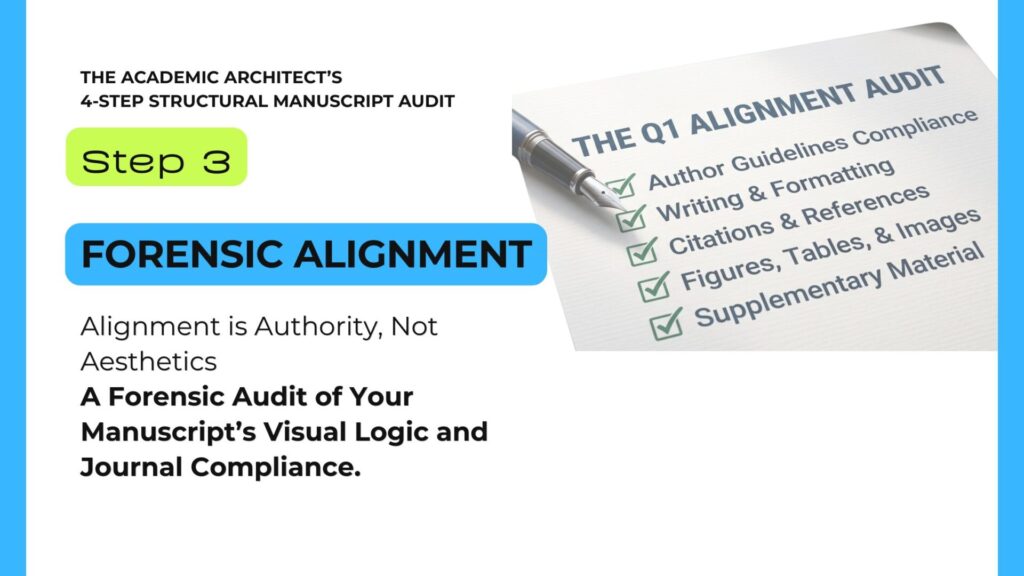
This is the phase of Forensic Alignment: The third pillar of our 4-Step Structural Audit Methodology.
II. The Diagnostic: The Dialect Mismatch
The primary reason for desk rejections is rarely the absence of “truth” in the data; it is a failure of positioning. Editors perform a rapid forensic scan of your work to determine if it speaks to the journal’s established discourse. When a manuscript lacks alignment, the dissonance is immediate.
You may have solved a complex problem, but if your contribution statement is positioned toward a different disciplinary paradigm than the journal’s core audience, the editor will effectively treat your paper as a “foreign” structure that does not fit the landscape.
Aligning your manuscript to the journal’s requirements is not about superficial tailoring; it is about demonstrating that your research is the missing piece in the journal’s ongoing scholarly conversation.
III. The Forensic Alignment Process: Three Pillars of Calibration
To ensure your manuscript is not just “submission-ready” but “acceptance-prone,” we subject it to three specific forensic checks:
1. Zoning Compliance (Scope & Strategic Positioning)
Does your manuscript’s “value proposition” match the specific editorial focus of the journal? We evaluate the introduction and conclusion not merely for flow, but for resonance. We refine the narrative to ensure that your contribution is framed in terms that the journal’s specific readership finds urgent and relevant. This is about moving from “general knowledge” to “journal-specific impact.”
2. Building Codes (Bibliographic and Data Integrity)
In the era of automated research tools, bibliographic integrity has become a liability. Editors are increasingly sensitive to “ghost” citations, formatting inconsistencies, and broken DOIs generated by AI tools. Our forensic audit involves a manual scrub of the reference ecology. We ensure that your bibliography is not just a list of sources, but a rigorously verified foundation that signals to the reviewer that your internal research processes are as disciplined as your primary data collection.
3. Structural Integration (The Citation Ecosystem)
Effective scholarship is an intertextual process. We ensure your work is positioned within the conversation already happening in the journal. This is not about arbitrary citation padding; it is about mapping the scholarly lineage that makes your findings inevitable. By weaving your argument into the journal’s existing intellectual fabric, we ensure your paper is perceived as an organic evolution of the journal’s current agenda.
IV. The “Architect’s” Edge: Manual vs. Automated
In an increasingly automated publishing landscape, forensic alignment serves as an audit of integrity. Automated tools can check for grammar, but they lack the discernment to understand editorial nuance or the tacit expectations of a specific Q1 board.
My forensic alignment process ensures that your manuscript is perceived not as an imported commodity, but as a native inhabitant of the journal’s core intellectual body.
With the manuscript forensically aligned, we arrive at the final gate: Step 4 — Definitive Submission. This concluding phase involves a rigorous final stress test of your cover letter, visual data presentation, and the strategic framing of your response strategy, ensuring your work is not just ready for the editor’s desk, but designed to compel a positive review from the moment it is opened.
This post concludes the deep dive into Step 3 of our 4-Step Structural Audit Methodology. If you are preparing for a Q1 submission and want to ensure your paper is forensically aligned from its theoretical positioning down to the minutiae of its reference ecology, I encourage you to book your assessment before my calendar fills for the upcoming cycle.
Do not leave the structural integrity of your career to chance. Let us audit the foundation of your manuscript before you hit submit.

About the Author
Siddhesh (Sid) Chaukekar is the Founder & Principal Manuscript Auditor at The Academic Architect. With 14+ years of forensic oversight across 8 high-impact disciplines, he has completed over 200 structural interventions with a 94% success rate. Sid holds specialised certifications from the University of London, Elsevier (Peer Review), and the APA (Statistics), providing a unique “Triple-Threat” of credentials to harden manuscript logic and data.