Introduction – Final Architectural Verification for Q1 Journal Success
A manuscript can be methodologically sound, theoretically grounded, and supported by a carefully constructed evidence base, yet still create resistance during peer review.
This is where the final stage of the Academic Architect’s 4-Step Structural Manuscript Audit becomes important. The earlier stages of manuscript auditing focus on structural integrity: whether the research question, theoretical framework, methodology, analysis, results, and contribution are properly aligned. Once that architecture has been strengthened, the manuscript enters a different stage of scrutiny.
The question is no longer simply: Is the manuscript structurally sound? It becomes: Is the manuscript aligned with the standards of the journal in which the manuscript is being submitted? This is the purpose of Step 4: Definitive Submission. In this step, the auditing process focuses on ensuring that your manuscript is calibrated as per the journal’s “Author Requirements”.
Beyond document preparation, the actual process of navigating submission portals like ScholarOne, Editorial Manager, or Elsevier System can take hours of valuable research time. Step 4 lifts this administrative burden entirely. From managing multi-author ORCID validations and institutional affiliations to conducting pre-flight plagiarism software audits and uploading complex supplementary files, every technical hurdle is pre-emptively cleared. By handling portal logistics and ensuring 100% compliance with ethical, data availability, and funding declarations, this step shields your manuscript from immediate desk rejection—guaranteeing a smooth transition from submission to official peer review.
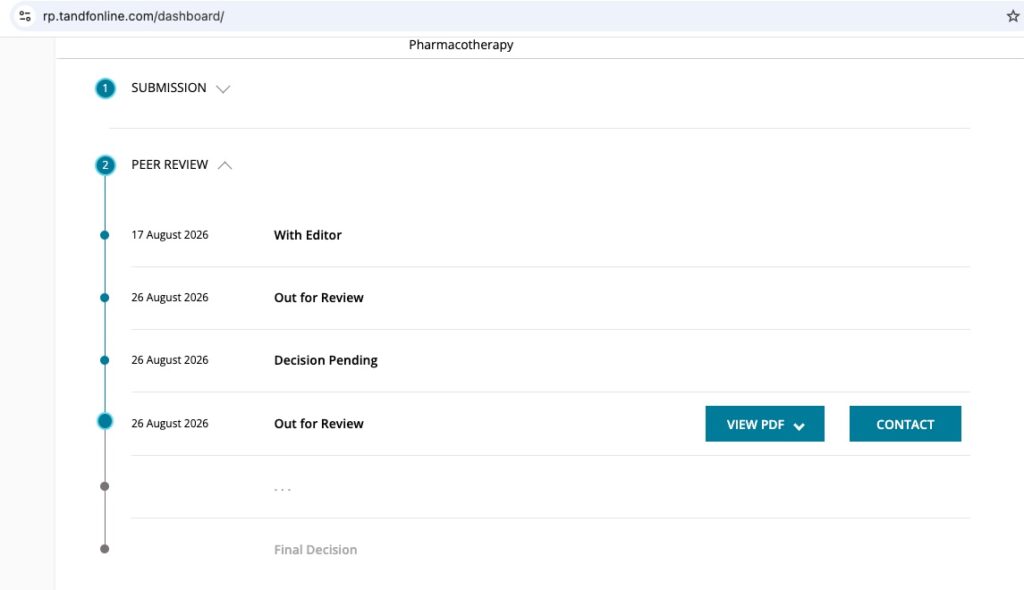
Real-time tracking dashboard showing a client manuscript successfully transitioning from initial submission to “Out for Review” status in a Q1 Taylor & Francis journal.
1. Title Formatting & Visual Calibration
Q1 journals operate on strict typesetting constraints, and failing to conform to their specific visual logic immediately signals an amateur submission. This aspect of the audit verifies that section headers, subheadings, and text hierarchy strictly follow the target journal’s structural rules—whether that requires a numbered decimal system, specific capitalization schemes, or precise font pairings. Simultaneously, figures and tables must meet exact technical specifications. Step 4 ensures that image resolutions (often requiring 300+ DPI in TIFF or EPS formats), vector graphics, column widths, and table formatting match the publisher’s layout requirements. When a manuscript’s visual geometry looks natively formatted for the journal, it moves through editorial triage without unnecessary friction.
Having navigated complex submission portals for Q1 titles across medical, social, and environmental sciences, I handle the tedious, high-stakes submission logistics so you can focus on your next research project.
2. Metadata, Citations, and Reference Management Calibration
Beyond basic layout, high-impact journals maintain uncompromising standards regarding citation mechanics and author metadata. Step 4 conducts a forensic review of your reference list, leveraging reference management software such as Zotero or EndNote to precisely execute citation calibration. By deploying Citation Style Language (CSL) files in Zotero or official Output Styles in EndNote, you can instantly transition an entire manuscript between complex citation frameworks—whether moving from an author-year format (e.g., APA 7) to a numbered system (e.g., IEEE or Nature). These tools automate intricate rules like journal title abbreviations, DOI link integration, and et al. thresholds. Step 4 pairs software automation with manual verification to ensure zero discrepancies exist between in-text citations and the final reference list.
3. Anonymisation, Front Matter, and Submission Documentation
For journals utilising double-blind peer review, this stage performs a rigorous anonymization check. All self-citations, author notes, file properties, acknowledgments, and institutional references are carefully masked or redacted to preserve review integrity. Furthermore, Q1 editors evaluate the entire submission bundle, starting with the cover letter. Step 4 aligns your cover letter directly with the journal’s scope, clearly articulating the manuscript’s novel contribution, declaring any conflicts of interest, and suggesting appropriate, non-conflicted reviewers. This step also verifies that all auxiliary documents, such as structured abstracts, running heads, targeted keywords, highlights, conflict of interest declarations, and data availability statements, are fully prepared according to the journal’s exact specifications.
4. The Final Quality Check
Ultimately, Step 4 serves as the final quality gate before pressing send. Treating journal compliance as an integral part of manuscript engineering transforms a stressful administrative task into a strategic advantage. By systematically eliminating formatting discrepancies, citation errors, and missing metadata, you remove every artificial barrier between your research and the peer reviewers. Definitive Submission ensures that when an editor opens your file, their focus remains entirely on the strength of your scholarship.
Conclusion
Navigating the intricacies of publisher guidelines should never stand between breakthrough research and a Q1 publication. While you have invested months engineering a methodologically rigorous manuscript, the administrative burden of portal submissions, technical typesetting, and journal compliance can easily consume valuable time or, worse, lead to frustrating desk rejections over preventable formatting oversights.
Step 4: Definitive Submission bridges this exact gap. From calibrating complex citation styles and anonymizing files to managing ScholarOne or Editorial Manager portals, I handle the high-stakes operational logistics top-tier journals require across medical, environmental, and social sciences.
If your manuscript is fully written and ready for submission, do not let tedious Author Guidelines slow your momentum. Book a 1-on-1 consultation today, and let’s turn your complete manuscript into an unassailable, submission-ready asset that moves seamlessly from upload to peer review.

About the Author
Siddhesh (Sid) Chaukekar is the Founder & Principal Manuscript Auditor at The Academic Architect. With 14+ years of forensic oversight across 8 high-impact disciplines, he has completed over 200 structural interventions with a 94% success rate. Sid holds specialised certifications from the University of London, Elsevier (Peer Review), and the APA (Statistics), providing a unique “Triple-Threat” of credentials to harden manuscript logic and data.