
Beyond the Correlation Coefficient: Engineering Structural Integrity for Q1 Success
In the ecosystem of Tier-1 finance journals, causality is never assumed; it is engineered.
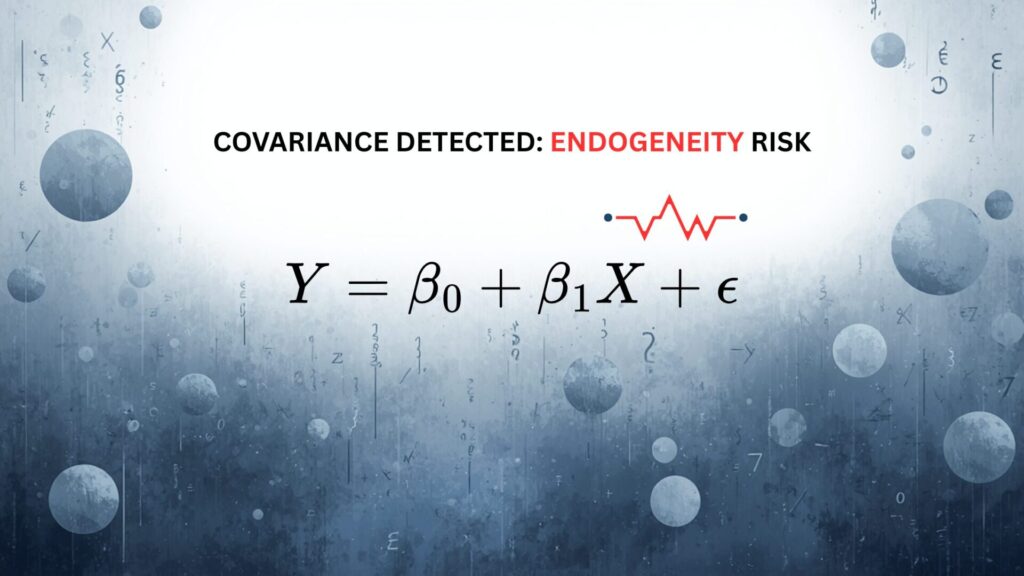
This success story follows a manuscript built on a rich dataset that faced a fatal structural vulnerability: The “Endogeneity Gap.” While the correlations were statistically significant, the paper lacked a hardened causal shield. From a reviewer’s perspective, the relationship between variables was open to interpretation, leaving the findings exposed to simultaneity bias and reverse causality.
Using Steps 1 (Structural Assessment) and 2 (Methodological Hardening) of The Academic Architect’s 4-Step Structural Audit Methodology, we performed a forensic scan of the manuscript’s empirical logic. By identifying the exact ‘attack surfaces’ where a reviewer would strike, we were able to rebuild the causal spine from the ground up. This case details how we transformed a high-risk draft into a ‘Reviewer-Proof’ blueprint, a process that serves as the foundation for our more comprehensive, end-to-end submission architectural services.
Causality is not assumed in elite finance publishing; it is engineered.
I. The Vulnerability: Data Without a Causal Shield
The manuscript at the center of this success story was built on a rich, well-constructed dataset and addressed a question of clear relevance to financial markets. The empirical analysis produced statistically significant results, and the descriptive patterns were compelling. However, despite these strengths, the paper faced a critical vulnerability at the peer-review stage: causality was implied but not sufficiently defended.
From a reviewer’s perspective, particularly at a Tier-1 finance journal such as the European Journal of Finance, this gap is decisive. The existing empirical blueprint relied on correlations that were open to multiple interpretations. Potential reverse causality, simultaneity bias, and omitted variable concerns remained insufficiently addressed. As a result, the relationship between the key explanatory and outcome variables was exposed to reviewer attack.
In finance publishing, strong data alone is never enough. Without a hardened strategy for addressing endogeneity in finance research, even robust datasets can be judged methodologically fragile. The paper was at risk of being classified as “interesting but not causal,”; a common and often fatal reviewer verdict.
II. The Forensic Audit: Identifying the Fault Lines
The first step was a structural audit of the econometric logic, not just the estimations themselves. Rather than asking whether the results were “correct,” the audit focused on a more important question: How would a skeptical reviewer try to dissect this paper?
This audit revealed that while the empirical correlations were consistent with the theoretical narrative, the manuscript did not sufficiently separate association from causation. The reviewers could plausibly argue that the explanatory variable was endogenous, driven by unobserved factors, reverse feedback loops, or simultaneous determination with the dependent variable.
At this stage, it became clear that incremental robustness checks would not be enough. What was required was a methodological reinforcement capable of isolating the causal channel explicitly. To address this, the study was re-designed to incorporate IV Probit and Two-Stage Residual Inclusion (2SRI) analyses. These techniques are particularly well-suited to nonlinear models and offer a defensible strategy for handling endogeneity without distorting the underlying research question.
This was not a cosmetic fix. It was a deliberate decision to rebuild the causal logic of the paper in a way that would withstand elite peer review.
III. The Structural Fix: Re-Engineering the Empirical Spine
The IV Probit and 2SRI frameworks were fully integrated into the econometric narrative.
The implementation phase focused on re-architecting both the Methodology and Results sections to make the causal defence explicit, transparent, and reviewer-proof.
First, the endogeneity problem was clearly named and motivated. Instead of burying the issue in technical footnotes, the revised manuscript openly acknowledged why simultaneity bias and reverse causation were plausible concerns in this context. This signaling alone marked a shift from a defensive to a confident scholarly posture.
Second, the IV Probit and 2SRI frameworks were fully integrated into the econometric narrative. Instrument selection was justified theoretically and empirically, first-stage relevance was discussed, and exclusion restrictions were clearly articulated. The paper no longer asked reviewers to “trust” the results; it showed precisely how the causal effect was isolated.
Third, the results section was reorganised to guide readers through the logic of causality step by step. Baseline correlations were presented as descriptive anchors, followed by the causal estimations that corrected for endogeneity. Differences between naïve and instrumented estimates were interpreted carefully, reinforcing the importance of the causal correction rather than overstating effects.
Through this process, the manuscript developed what can only be described as a hardened causal spine—one that aligned fully with the expectations of finance reviewers trained to interrogate identification strategies.
IV. The Outcome: From Vulnerable to Publication-Ready
With the endogeneity gaps closed and the causal logic fortified, the manuscript moved decisively from a vulnerable state to a publication-ready blueprint. The revised paper no longer relied on implied causality; it demonstrated it through rigorous econometric design.
More importantly, the revisions repositioned the author from a reactive respondent to a methodologically authoritative scholar. By directly addressing causality versus correlation in econometrics and by transparently correcting for simultaneity bias, the paper met the intellectual standards expected by Tier-1 finance journals. By identifying and fixing the endogeneity fault lines early, the manuscript emerged stronger, clearer, and fully aligned with the demands of top-tier peer review.
Note on Forensic Integrity: The Academic Architect is a specialised consultancy focused on methodological hardening and structural auditing; as such, we do not provide traditional writing, proofreading, or copy-editing services. Our forensic workflow is designed to strengthen the author’s original logic and argument flow without substituting their voice or rewriting their intellectual property. Our audits serve to identify “structural cracks” and ensure Q1 journal alignment, ensuring that the final manuscript is a defensible scholarly structure that remains the sole intellectual property of the researcher.