Introduction
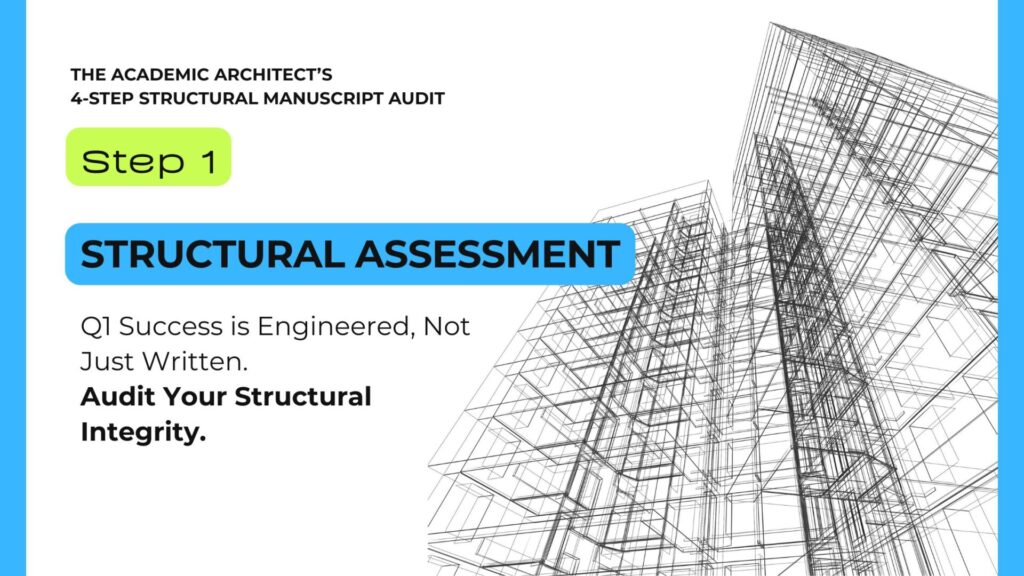
The most critical stage of a high-impact manuscript isn’t the final polish; it’s the strength of its foundational logic. As the first phase of our proprietary 4-Step Structural Manuscript Audit, the Structural Assessment is designed to stress-test your paper’s “Causal Spine” across any empirical discipline.
Our primary objective in Step 1 is to identify and resolve Structural Debt. For many researchers, shortcuts taken during the drafting phase, such as vague theoretical boundaries, unaddressed endogeneity, or “Aesthetic Mirages” of polished prose, act as a high-interest loan against their career.
While these shortcuts make a paper look “submission-ready”, the debt always comes due during peer review. By performing a forensic gap analysis before you submit, we identify these hidden liabilities and “harden” your narrative, ensuring your intellectual architecture is load-bearing before a reviewer ever sees it.
The “Sinking Foundation” Phenomenon
Every year, exceptionally intelligent researchers submit manuscripts that appear polished, articulate, and methodologically sophisticated. However, they still receive swift and devastating desk rejections.
The language is refined. The literature review is extensive. The analysis is technically competent. And still, the editorial decision arrives within days: Not suitable for review. The problem lies in a misconception about what a manuscript truly represents.
A research paper is not a story crafted for aesthetic elegance. It is a structural blueprint designed to withstand technical scrutiny. When its conceptual foundation is unstable, no degree of academic polish can compensate. Elegant prose becomes an aesthetic mirage or a surface-level refinement that hides deeper architectural weaknesses.
Our Structural Assessment serves as a preemptive strike against reviewer skepticism. Before equations are refined or robustness tests are added, the manuscript’s conceptual load-bearing framework must be evaluated.
Editors and reviewers are trained to detect instability. They do not merely evaluate clarity or novelty; they stress-test the internal logic of the manuscript. If the foundation is weak, the structure collapses under even modest scrutiny.
Our Structural Assessment serves as a preemptive strike against reviewer skepticism. Before equations are refined or robustness tests are added, the manuscript’s conceptual load-bearing framework must be evaluated. The mission is simple: Ensure the foundation can support the weight of the argument.
Defining the Concept: What is “Structural Debt”?
Structural debt accumulates when researchers take intellectual shortcuts during drafting. These shortcuts may appear harmless at first, but create vulnerabilities that compound over time.
Examples include vaguely defined theoretical boundaries, unaddressed endogeneity concerns, weak causal logic, or ambiguous variable relationships. Each shortcut functions like a high-interest intellectual loan taken against the manuscript’s credibility.
Initially, the paper may appear complete. But the debt remains embedded within its logic. When peer reviewers begin their examination, the repayment becomes unavoidable. This is when structural debt “comes due.”
Examples of structural debt include vague theoretical boundaries, unaddressed endogeneity concerns, weak causal logic, or ambiguous relationships among variables. Each shortcut functions like a high-interest intellectual loan taken against the manuscript’s credibility.
Reviewers probe causal assumptions. They test theoretical alignment. They question identification strategies. Logical inconsistencies that once seemed minor now appear fatal. The manuscript’s structure fractures under scrutiny. The result is not incremental revision. It is a catastrophic structural failure.
The solution requires a mindset shift. Researchers must move beyond “writing a paper” and begin engineering a thesis. Writing emphasises expression. Engineering emphasises structural integrity. A structurally sound manuscript is designed, stress-tested, and fortified before exposure to adversarial review.
The Forensic Lens: What we Audit in Step 1
Step 1 – Structural Assessment applies a forensic lens to three critical components of a manuscript’s architecture.
1. The Causal Spine
The causal spine is the load-bearing pathway connecting the research question to the conclusions. Every empirical claim must travel through this spine without logical rupture. If causal direction is ambiguous, if key mechanisms are assumed rather than demonstrated, or if alternative explanations remain unaddressed, the spine weakens. A fragile causal spine cannot withstand reviewer interrogation, whether in Finance, Management, Sociology, or interdisciplinary domains.
2. Theoretical Scaffolding
Theoretical scaffolding explains why the study must exist. It clarifies why existing literature cannot sufficiently explain the phenomenon. Many manuscripts fail not because they lack literature, but because they fail to identify a theoretical vacuum. They summarise prior studies without identifying unresolved tensions, contradictions, or missing mechanisms. Without scaffolding, the manuscript appears additive rather than essential.
3. Boundary Conditions
Every rigorous study operates within limits. These limits define scope, applicability, and interpretive caution. When boundary conditions remain vague, reviewers find “cracks” in the structure. They question generalisability, sample logic, and contextual validity. The argument becomes easier to dismantle. Structural Assessment ensures that limitations are not liabilities but controlled design parameters.
Case Study: The “Gap” vs. The “Hardening”
Consider a common example of the aesthetic mirage:
“While prior studies examine corporate governance and firm performance, limited research explores their interaction in emerging markets, thereby justifying this study.”
The sentence appears academic and polished. Yet it conceals structural weakness. The logical leap is immediate. The existence of “limited research” does not establish necessity. It does not identify a mechanism, unresolved conflict, or theoretical deficiency. The justification rests on absence rather than intellectual need.
The Audit Result
The Structural Assessment identifies this as theoretical debt compounded by potential reverse causality and a missing counterfactual framework. The reviewer’s question emerges instantly: Why does this gap matter?
The Transformation
The paragraph is re-architected to anchor the gap in the mechanism:
“Existing governance-performance models assume institutional stability, yet emerging markets exhibit regulatory volatility that alters incentive alignment mechanisms. This destabilises prevailing causal assumptions, necessitating a re-examination of governance-performance dynamics under institutional flux.”
The revised structure replaces superficial absence with mechanistic necessity. The argument becomes load-bearing.
The Reviewer’s Lens: Detecting the “Rot”
Reviewers rarely begin with the methodology. Their decision trajectory often forms within the first five pages. These early sections signal whether the manuscript is structurally viable or intellectually fragile.
Several red flags trigger skepticism:
- Over-promising contributions that exceed evidence.
- A defensive tone that anticipates criticism without addressing it.
- Vague identification strategies that rely on rhetorical persuasion rather than design logic.
- Ambiguous variable definitions that suggest conceptual looseness.
These cues create what reviewers recognise as the scent of weakness. Once detected, confirmation bias accelerates the rejection trajectory. Structural Assessment eliminates these signals before submission.
Conclusion: Pay the Debt Now, or Pay the Reviewer Later
Step 1 of the Structural Audit Methodology ensures that the research blueprint is viable before methodological construction begins. It verifies that the causal spine is load-bearing, the theoretical scaffolding is necessary, and boundary conditions are structurally sealed.
Without this step, methodological sophistication cannot prevent collapse. With it, the manuscript enters peer review as an engineered intellectual structure rather than a stylistic artifact.
With the architectural framework now firmly in place, the next phase moves beyond the layout to Step 2: Methodological Hardening, where we stress-test and audit the structural integrity of every technical claim to ensure definitive reliability.
Until then, one question remains: Is your causal spine load-bearing?
Book a 15-minute Structural Scan to identify your logical gaps before the reviewers do.

About the Author
Siddhesh (Sid) Chaukekar is the Founder & Principal Manuscript Auditor at The Academic Architect. With 14+ years of forensic oversight across 8 high-impact disciplines, he has completed over 200 structural interventions with a 94% success rate. Sid holds specialised certifications from the University of London, Elsevier (Peer Review), and the APA (Statistics), providing a unique “Triple-Threat” of credentials to harden manuscript logic and data.